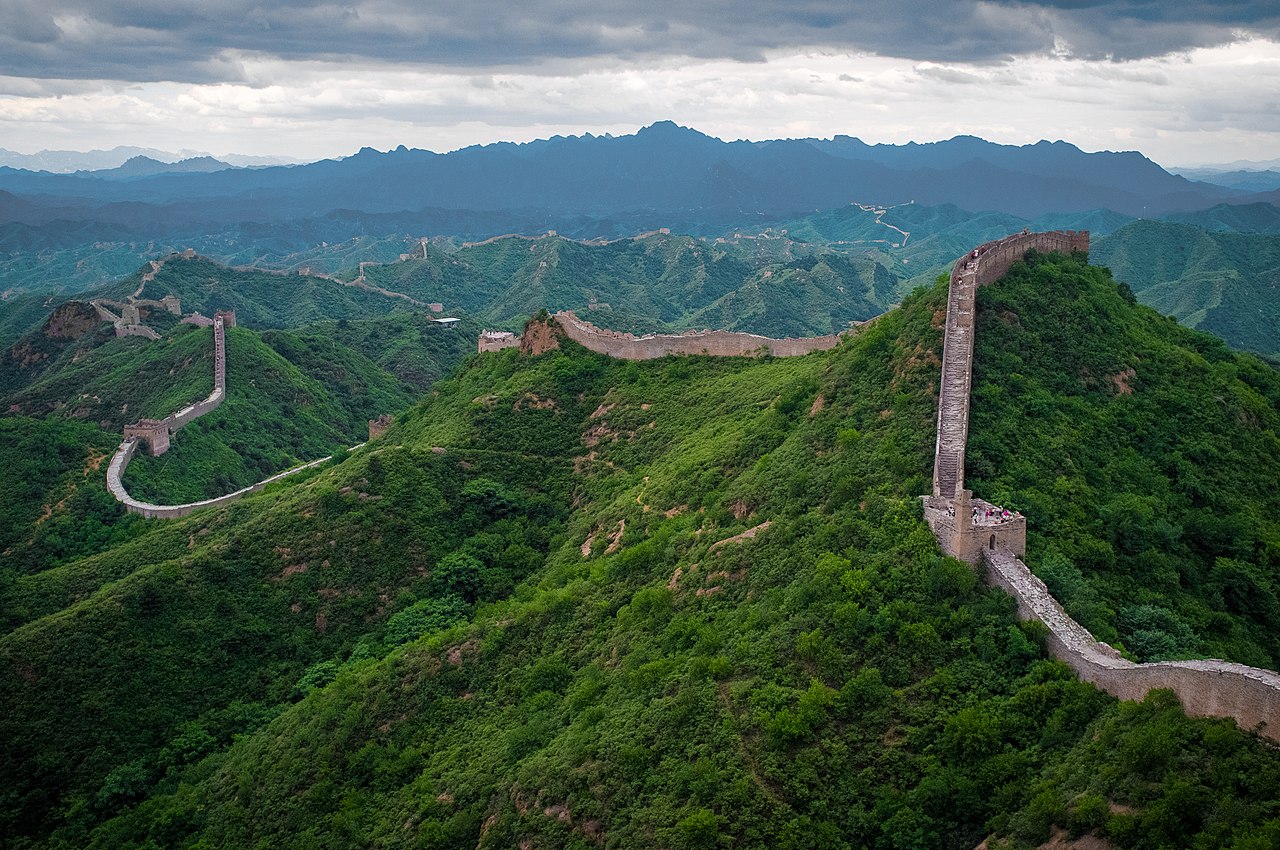
Late one night more than two thousand years ago, a garrison soldier stood on a beacon tower on the ridge, gazing into the darkness beyond the border. He could not have known that the wall of rammed earth and stone beneath his feet would keep growing, stretching and changing course for more than twenty centuries — spanning ten thousand li of northern China — to become the largest defensive structure in human history, and a spiritual totem of a civilisation that endures to this day.
This is the past and present of the Great Wall.
History · Timeline
8 key moments- 17th–3rd c. BCE
Walls of the Warring States
Early fortifications such as the Fangcheng wall; Yan and Zhao build along the farming–steppe frontier
- 2221 BCE
Qin Shi Huang joins the walls
Meng Tian drives out the Xiongnu and links the old walls into a "Ten Thousand Li" line
- 32nd c. BCE
The Han opens the Silk Road
The Wall extends to the Hexi Corridor, guarding the Silk Road and its four commanderies
- 43rd–7th c.
Repairs in troubled times
Northern Wei, Northern Qi, Sui and Tang rebuild the northern frontier repeatedly
- 51368–1644
The Ming's brick-and-stone dragon
Nine frontier towns and Qi Jiguang's hollow watchtowers forge today's Great Wall
- 61691
Kangxi halts construction
"To hold the state, cultivate virtue and reassure the people" — passes become trading towns
- 71933
The Great Wall War of Resistance
Fierce fighting at Xifengkou; a new Great Wall is built of flesh and blood
- 81987
Inscribed as World Heritage
One of China's first six World Heritage properties, guarded by all humanity
Prologue: A Handful of Earth
The Great Wall did not begin with brick or stone. It began with a handful of earth, pounded hard.
At dusk, some twenty-seven hundred years ago, on the frontier of the state of Chu, labourers swung wooden mallets, driving yellow earth into the wall-moulds, blow by blow. No one then knew the wall would one day be called the “Great Wall” — or that it would grow across twenty-seven centuries, through wars and dynasties, spanning fifteen provincial regions, from the Yalu River to the foot of the Tianshan: the largest defensive project in the history of human civilization.
It began, humbly, by keeping out the neighbours.
The Walls of Chu
In the seventh century BC, the state of Chu raised a chain of ramparts across Fangcheng Mountain — the earliest recorded forerunner of the “Great Wall”. Qi, Yan, Zhao, Wei and Qin all followed suit. In an age of warring states, a wall was the plainest form of safety.
The states that truly built to the edge of survival were Yan and Zhao, facing the horsemen of the northern steppe. King Wuling of Zhao adopted “barbarian dress and mounted archery” — narrowing his robes, learning to shoot from horseback — and raised walls at the foot of the Yin Mountains. Inside the wall, farmland; outside, grassland. From its very birth, this wall carried the anxiety of survival.
The “first stone” of the Great Wall was not laid by the First Emperor, but by anxious kings of the Warring States, some twenty-seven hundred years ago.
Meng Tian’s Three Hundred Thousand
In 221 BC, Qin Shi Huang conquered the six states. The following year he sent his general Meng Tian with three hundred thousand men to drive back the Xiongnu, linking and repairing the old walls of the Warring States — from Lintao in the west to Liaodong in the east. Thus the “Ten Thousand Li Wall” was born.
This wall also inherited China’s most famous “injustice”: the legend of Meng Jiangnu, whose husband was taken to build the wall and whose tears brought eight hundred li of it down. Historians trace the tale to a story from the Spring and Autumn period, later grafted onto the First Emperor in Tang times. Legend is not history — but the fact that the legend survived two thousand years says more than the wall itself: in the ancient imagination, this wall was bound to the joys and griefs of countless families.
The corvée labourers, the frontier soldiers, the families waiting for their return — these, not the emperors, were the wall’s true masters.
Bells and Camels Out of Yangguan
Qin fell, Han rose, and the wall underwent its first transformation.
Emperor Wu sent Wei Qing and Huo Qubing north against the Xiongnu, pushing the frontier from the Central Plains to the Hexi Corridor. After Zhang Qian opened the road to the Western Regions, the wall became more than a military work — it became a corridor of civilizations: the four commanderies of Wuwei, Zhangye, Jiuquan and Dunhuang lined up along it, with Yumen Pass and Yangguan guarding the throat of the Silk Road.
“One more cup of wine, friend — west of Yangguan, no old acquaintance.” The bleak pass of Tang poetry once rang with camel bells: silk, tea and porcelain out; grapes, alfalfa and Ferghana horses in. The gates of the Great Wall never only “kept enemies out” — they also “let friends through”.
Qi Jiguang’s Hollow Watchtowers
Between Han and Tang, the empire split and reunited endlessly, yet the wall never stopped being built. The Northern Wei, Northern Qi and Northern Zhou rebuilt it repeatedly; the Sui emperors restored it on a vast scale. In troubled times, every stretch of wall was the last line of a farming civilization before the cavalry — if it stood, home stood.
But the wall’s true zenith came more than a millennium later, from the dynasty that rebuilt the empire in brick and stone: the Ming.
In 1368, Zhu Yuanzhang took the throne in Nanjing, following his adviser Zhu Sheng’s nine-character maxim: “Build high walls, store ample grain, and take the throne slowly.” For more than two hundred years the Ming poured the resources of the whole empire into transforming the wall from rammed earth into brick and stone — from Hushan by the Yalu River in the east to Jiayuguan in Gansu in the west, guarded by the nine frontier garrisons. The magnificent walls we see today at Badaling and Mutianyu were almost all built by Ming hands.
One story is worth remembering above all: in 1567, the anti-pirate general Qi Jiguang was transferred to command the Jizhen frontier. Along the wall he raised more than a thousand “hollow watchtowers” — garrisoned, provisioned, with overlapping fire so that attackers could not climb. For sixteen years he held the frontier, and the beacon fires never rose.
The Ming wall was not a wall but a complete defensive system: wall, pass, fort, beacon — each link connected to the next.
The Year Kangxi Stopped Building
History turns at the most unexpected moments.
In 1644, the Qing entered the passes — for the first time, a steppe people ruled the Central Plains. Suddenly the wall that had guarded against the steppe for two thousand years had no one to guard against.
In 1691, urged to rebuild the wall, the Kangxi Emperor replied: “Qin built the wall, and Han, Tang and Song all repaired it — yet border troubles never ceased… The way to keep the state is to cultivate virtue and pacify the people.” From that day, the wall was never rebuilt. Gubeikou, Zhangjiakou and other passes doffed their armour and became markets for tea-and-horse trade — inside and outside the wall, for the first time, truly one family.
A New Great Wall of Flesh and Blood
The wall stopped being built, but its story did not stop.
In 1933, as Japanese forces pressed into North China, Chinese troops fought desperate battles along the wall at Xifengkou and Gubeikou. Soldiers of the 29th Army met the enemy blade-to-blade with their dadao broadswords, and the song “Slash down the Japanese heads!” rang along the wall.
Two years later, Tian Han wrote the words of the March of the Volunteers: “Build our new Great Wall with our flesh and blood.”
In that moment the wall completed its greatest transformation: from a military work of brick and stone into a spiritual symbol of a people sworn to defend their home. Mao Zedong’s line “He who has not reached the Great Wall is no hero” made it, for generation after generation, a summit every Chinese felt they must reach.
1987: An Englishman and a Chinese Wall
In 1987, a young Englishman named William Lindesay gave up his job and set out on foot from Jiayuguan toward Shanhaiguan — more than 2,400 kilometres, seventy-eight days, measuring the whole wall one stride at a time. He later settled in China, founded the International Friends of the Great Wall, and spent a lifetime organising volunteers to pick litter off the wall. The wall “captured” him for the rest of his life.
In that same year, 1987, the Great Wall — one of China’s first six World Heritage properties — was inscribed together with the Forbidden City, the Mogao Caves, the Mausoleum of the First Emperor, Peking Man and Mount Tai. The 1984 “Love China, Restore the Great Wall” campaign saw ordinary citizens donate their savings; in 2006, the Regulations on the Protection of the Great Wall came into force — the first time China enacted a dedicated law for a single monument. Today the Great Wall National Cultural Park is taking shape, and the ancient wall is being carried into the future, digitised metre by metre.
Epilogue: The Night He Watched
More than two thousand years ago, in the deep night, a garrison soldier stood on a beacon tower on the ridge, gazing at the dark beyond the pass.
More than two thousand years later, when you climb the same wall and look at the same moonlight — you understand at last: the Great Wall is not a relic to be visited, but a wall of the heart that is still growing. It was piled for twenty-seven centuries, and in every handful of earth is pounded a person’s determination to keep a home.
Outstanding Universal Value (OUV)
- Criterion (i): The Great Wall is a masterpiece of human creative genius; its planning, design and construction were a wonder by the engineering standards of the time.
- Criterion (ii): The Wall’s defence system, frontier trading towns and cultural exchanges bear witness to a long and profound interchange between agrarian and nomadic civilisations.
- Criterion (iii): As an exceptional testimony to a military defence tradition sustained for more than two millennia, it embodies the unique survival wisdom of Chinese civilisation.
- Criterion (iv): The Great Wall is an outstanding example of military defensive architecture; its multi-layered “wall–pass–fort–terrace” structure influenced the city-building traditions of East Asia.
- Criterion (vi): The Wall is directly and tangibly associated with the collective memory and patriotic sentiment of the Chinese nation, and has become its shared spiritual symbol.
Facts at a Glance
- Total length of all dynasties’ walls: 21,196.18 km (published by China’s State Administration of Cultural Heritage, 2012)
- Of which the Ming Wall: 8,851.8 km — the best-preserved and most magnificent section
- Spanning 15 provincial-level regions, from the banks of the Yalu River to the foot of the Tianshan range
- The Ming Wall alone once had more than 7,000 watchtowers and over 10,000 beacon towers
One wall, twenty-seven centuries, ten thousand li of mountains and rivers. Its past was the perseverance of an agrarian civilisation before the cavalry of the steppe; its present is the shared spiritual home of the Chinese people. This is the Great Wall.
Gallery

Mutianyu (Beijing) — one of the best-preserved Ming sections
Wikimedia Commons / Lloyd Tudor · CC BY-SA 4.0

Simatai (Beijing) — famed for its steepness; watchtowers and wall ride the ridgeline
Wikimedia Commons / Walter Grassroot · CC BY-SA 3.0

Jiankou (Beijing) — the unrestored "wild Great Wall", dramatic and dangerous
Wikimedia Commons / Villa of the Papyri · CC BY-SA 4.0

Badaling (Beijing) — the most familiar image of the Wall
Wikimedia Commons / CEphoto, Uwe Aranas · CC BY-SA 3.0

Shanhaiguan "First Pass Under Heaven" (Hebei) — eastern terminus of the Ming Wall
Wikimedia Commons / Caitriana Nicholson · CC BY-SA 2.0

Jiayuguan (Gansu) — western terminus of the Ming Wall, "The Mightiest Pass Under Heaven"
Wikimedia Commons / David Stanley · CC BY 2.0

Yumen Pass ruins (Gansu) — western gateway of the Han Wall, "no spring wind blows beyond"
Wikimedia Commons / Brookqi · CC BY-SA 3.0

Yangguan beacon-tower ruins (Gansu) — the desolate pass of Tang poetry
Wikimedia Commons / Brookqi · CC BY-SA 3.0
Sources & Citation
- Official listing:UNESCO World Heritage Centre —— 长城
- Managing authority:http://www.ncha.gov.cn/
- Cover credit:Wikimedia Commons / User:Severin.stalder (CC BY-SA 3.0)
This is a public-interest open-source project; all data is strictly sourced. If you find an error or a mis-attributed image, please report it through the correction channel and we will fix it promptly.Report an error.