Three thousand quartz-sandstone pillars rise from the valleys of Zhangjiajie like swords, like brushes, like screens. A hundred million years of wind and water have carved here a forest of stone that seems to belong to no world of men.
History · Timeline
4 key moments- 1350 million years ago
Sandstone is deposited
A shallow sea lays down thick quartz sandstone, the raw material of the pillars
- 2Since the Cenozoic
The pillars take form
Uplift and stream erosion sculpt more than three thousand sandstone columns
- 31982
Zhangjiajie National Forest Park
China's first national forest park is established at Zhangjiajie
- 41992
Inscribed as World Heritage
Selected under criterion (vii)
Prologue: Pillars in the Mist
At dawn, thick mist fills the valleys of Wulingyuan.
A mountain keeper stands on the track, watching the stone pillars rise out of the fog one by one — like swords, like brushes, like screens, the tallest more than two hundred metres high. He has kept watch among these peaks for most of his life, yet he still cannot say what hand carved these stones that look hewn by knife and axe.
The answer lies in no human hand. It lies three hundred and fifty million years away.
Three Hundred and Fifty Million Years Beneath the Sea
Three hundred and fifty million years ago, the Wulingyuan area lay beneath a shallow sea. On the seabed, quietly, quartz sandstone hundreds of metres thick was laid down, layer upon layer — no one saw it, no one named it; only water, patiently stacking rock.
Those sandstones are the raw material of the more than three thousand pillars that stand here today.
Sculpted by Water and Wind
Since the Cenozoic, the crust has risen and the sea has retreated. Streams eroded along the vertical joints of the rock, cutting and hollowing it out; cliff faces collapsed and peeled away under their own weight — eons of water and wind worked like a tireless sculptor, carving the whole formation into more than three thousand stone pillars, the tallest over two hundred metres. The Golden Whip Stream threads among them, and when mist wraps the peaks, the whole range looms and vanishes like a fairy realm.
Later, geologists gave this kind of landscape a name: “Zhangjiajie landform.”
1982: China’s First National Forest Park
For ages, this forest of stone lay hidden in the deep mountains of western Hunan, known to few.
In 1982, the Zhangjiajie National Forest Park was founded — China’s first national forest park. From then on the footsteps on the mountain paths multiplied: botanists, photographers, the first tourists. The hidden land began to open to the world.
The Mountain Called Hallelujah
The moment Wulingyuan truly stepped onto the world stage came with a film.
The “Hallelujah Mountain” of Avatar was modelled on the Southern Heaven Pillar of Wulingyuan — a stone pillar that seems to hang in the air, giving audiences around the globe their first direct sight of “Zhangjiajie landform.” When the images travelled the world, this stone forest hidden in western Hunan at last entered the world’s view.
1992: Wonderful Peaks Belonging to All Humanity
In 1992, the Wulingyuan Scenic and Historic Interest Area was inscribed on the World Heritage List under criterion (vii), covering the three scenic zones of Zhangjiajie, Suoxiyu and Tianzi Mountain.
Today the Bailong elevator, the glass walkways and three thousand fantastic peaks have made Wulingyuan the world’s ambassador of “Zhangjiajie landform.” This masterwork of nature belongs to all humanity.
Epilogue: When the Mist Parts
At dawn the mist rises again, and the three thousand pillars float out of the fog once more.
The mountain keeper has watched for most of his life, and now at last he understands: the hand that carved these peaks was never a god. It was three hundred and fifty million years of time, and water and wind that never stopped. And all we can do is keep watch over this heritage — for all humanity.
Outstanding Universal Value (OUV)
- Criterion (vii): The landscape of more than three thousand quartz-sandstone pillars, gorges and streams possesses an unsurpassed natural aesthetic value.
Facts at a Glance
- More than 3,000 sandstone pillars, with up to about 200 m of relative relief
- Inscribed in 1992; Zhangjiajie is China’s first national forest park
Gallery

Scenery of Huangshi Village in Wulingyuan
Wikimedia Commons / 颐园居 · CC BY-SA 4.0

Wulingyuan viewed from Tianzi Mountain
Wikimedia Commons / Photo taken by Gjl · CC BY-SA 3.0

Sandstone pillars of Wulingyuan
Wikimedia Commons / Kuruman from Tokyo, Japan · CC BY 2.0
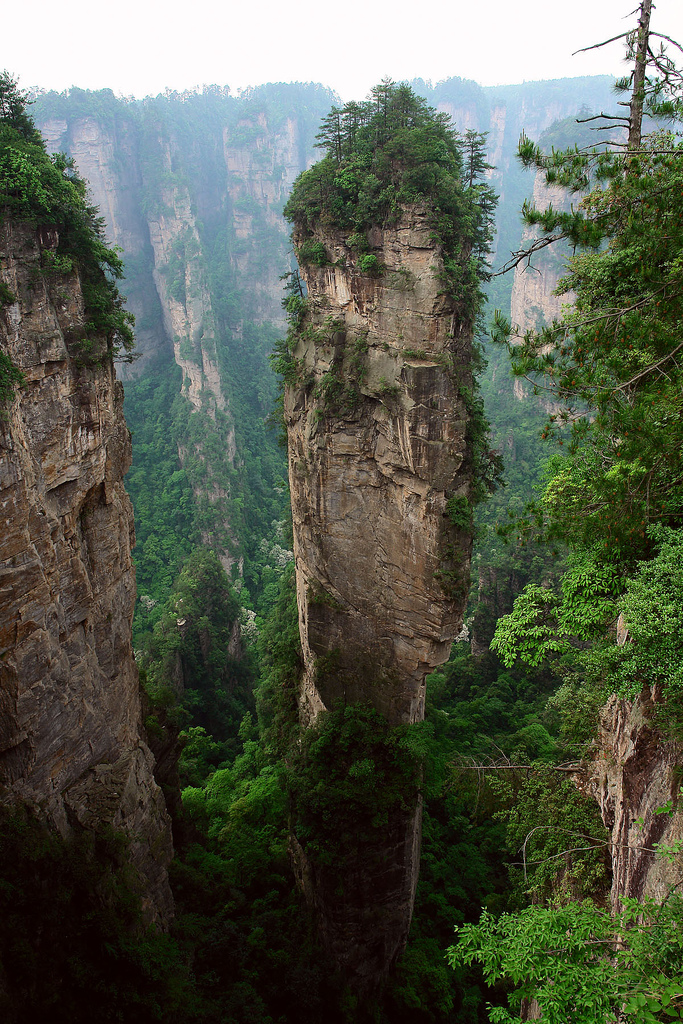
Pillars and valleys of Wulingyuan
Wikimedia Commons / John Philip · CC BY-SA 2.0
Sources & Citation
- Official listing:UNESCO World Heritage Centre —— 武陵源风景名胜区
- Managing authority:http://www.zjj.gov.cn/c32/20231213/i841185.html
- Cover credit:Wikimedia Commons / 颐园居 (CC BY-SA 4.0)
This is a public-interest open-source project; all data is strictly sourced. If you find an error or a mis-attributed image, please report it through the correction channel and we will fix it promptly.Report an error.