Bamboo rafts glide down the Nine-Bend River between red Danxia cliffs; Zhu Xi's Wuyi Academy hides in the deep woods; boat coffins have hung on the precipices for more than three thousand years. Mount Wuyi — a mountain sacred to three religions, the cradle of Neo-Confucianism, and the source of black tea and rock tea.
History · Timeline
4 key moments- 1Shang–Zhou period
Boat coffins in the cliffs
Ancient Yue people place boat coffins in Danxia caves, a mystery that survives to this day
- 21183
Zhu Xi builds his Wuyi Academy
Zhu Xi establishes his academy below Yimping Peak and teaches and writes there for more than a decade
- 3Ming dynasty
Dahongpao becomes tribute tea
Wuyi rock tea gains fame; Dahongpao is offered to the imperial court
- 41999
Inscribed as World Heritage
Selected as a mixed cultural and natural property under criteria (iii), (vi), (vii) and (x)
Prologue · A Raft Enters the Painting
In the early morning, a thin mist wraps the Nine-Bend River, and the boatman’s pole touches the water — the bamboo raft slides from the bank. The bow parts the current, and the red Danxia cliffs recede slowly on either side: water of green, mountains of red, mist of white, like a painting that has just received its final coat of colour.
This river has carried people for thousands of years. And on its banks lies the secret of a “dual heritage”: boat coffins from three thousand years ago on one side, the sound of study from more than eight hundred years ago on the other.
Three Thousand Years on the Cliff Face
In the Shang–Zhou period, the ancient Yue people set their boat-shaped coffins in the caves of the sheer cliffs along the Nine-Bend River — dozens of them, hanging there for more than three thousand years.
The coffins float above the water, touching neither heaven nor earth. Why did the Yue people labour to lift their dead onto the precipices? And how did they place the heavy wooden boats inside the caves? It remains a mystery to this day. Three thousand years have passed; the river still flows, the coffins still hang — the oldest question of Mount Wuyi.
The Sixteenth Grotto-Heaven
In the Wei and Jin periods, Taoist adepts traced the river upstream and built their hermitages among the Danxia peaks — and Mount Wuyi acquired its title of the “Sixteenth Grotto-Heaven” of Taoism. From the late Tang onward, Zen temples lined the riverbanks, and the sound of bells and chanting drifted between the valleys.
The incense of three teachings rose on the same mountain: Confucian, Buddhist and Taoist, each letting the others be. Wuyi became one of the few mountains of southern China where three teachings truly gathered in one place.
Zhu Xi’s Academy in the Mountains
In the Southern Song, the great Neo-Confucian scholar Zhu Xi came to Mount Wuyi. In 1183, he built his Wuyi Academy below Yimping Peak, writing and teaching there for more than a decade, bringing Neo-Confucianism to its synthesis. Scholars such as Cai Yuanding and You Zuo built their huts nearby to follow him — and the academy in the mountains became one of the most influential centres of learning of its age.
Mount Wuyi, thus, became the cradle of Chinese Neo-Confucianism.
A Leaf of Rock Tea
In a rock crevice of Jiulong’ao grow the mother trees of Dahongpao. Their roots sink into the Danxia strata, and sunlight and rain become the richness at the tips of their leaves — the people of Wuyi say that this tea carries “rock-bone and flower-fragrance.”
In the Ming dynasty, Wuyi rock tea gained fame and Dahongpao became tribute tea. A wisp of tea fragrance left the mountains, drifting from the valleys of Fujian toward the whole world — Mount Wuyi became one of the birthplaces of the world’s black tea.
A Dual Heritage of Mountain and Water
In 1999, Mount Wuyi was inscribed on the World Heritage List under criteria (iii), (vi), (vii) and (x) — a mixed cultural and natural property.
Today rafts still carry visitors down the Nine-Bend River through Danxia cliffs and tea gardens; the sea of clouds still surges at sunrise over Tianyou Peak; Dawang Peak still guards the river’s mouth — mountain and water, academy and incense, tea fragrance and hanging coffins together compose the irreplaceable character of this “dual heritage.”
Epilogue · The River Answers
When the raft turned the third bend, the mist lifted.
Three thousand years ago, the Yue people set their coffins into the cliffs; eight hundred years ago, Zhu Xi set his desk on the riverbank; today, your raft glides between the two. The Nine-Bend River does not speak, yet it answers every question with its water: the mountain remains, the water remains, the mystery remains — and so does the beauty of Wuyi.
Outstanding Universal Value (OUV)
- Criterion (iii): The boat coffins and Zhu Xi’s academy are exceptional testimony to ancient beliefs and scholarly traditions — the cultural distillation of the mountain’s convergence of Confucianism, Buddhism and Taoism.
- Criterion (vi): Directly associated with Zhu Xi’s Neo-Confucianism and the tradition of Chinese tea culture.
- Criterion (vii): The Nine-Bend River and the Danxia peaks form an exceptionally rare landscape of scenic beauty — an outstanding representative of natural aesthetics in southeastern China.
- Criterion (x): Preserving rich subtropical biodiversity, the mountain is habitat for rare flora and fauna.
Facts at a Glance
- The Nine-Bend River runs through the property; a mixed cultural and natural heritage
- Inscribed in 1999; Zhu Xi’s Wuyi Academy was the cradle of Neo-Confucianism
Gallery

The Nine-Bend River of Mount Wuyi
Wikimedia Commons / Windmemories · CC BY-SA 4.0

Danxia peaks of Mount Wuyi
Wikimedia Commons / Windmemories · CC BY-SA 4.0
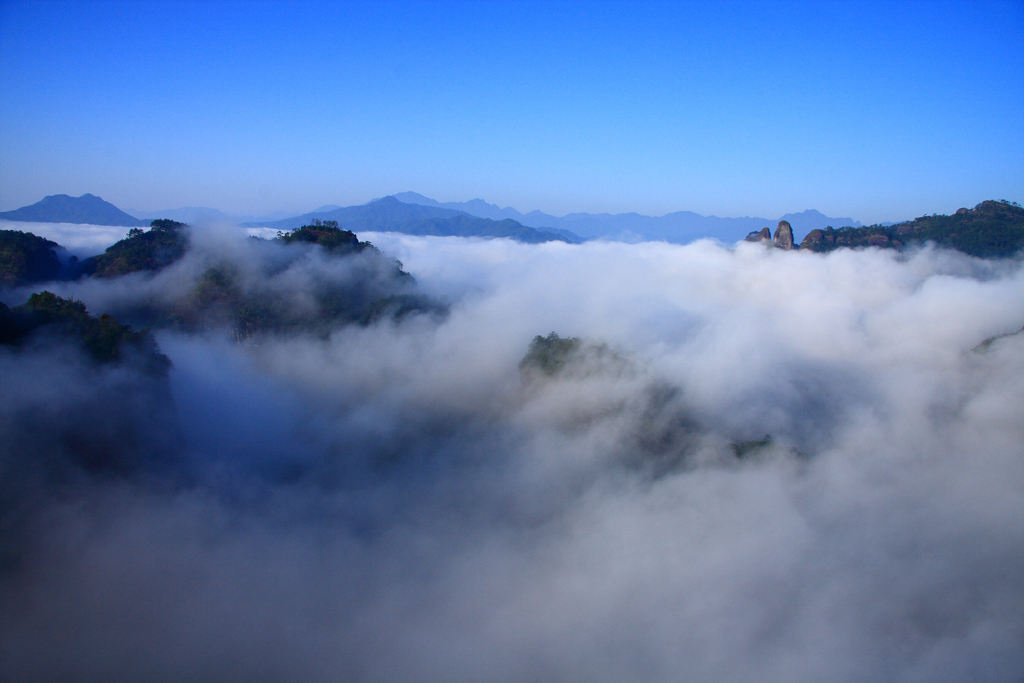
Sea of clouds over Mount Wuyi
Wikimedia Commons / 老过 · CC BY 2.5 cn

UNESCO World Heritage marker at Mount Wuyi
Wikimedia Commons / Gisling · CC BY-SA 3.0
Sources & Citation
- Official listing:UNESCO World Heritage Centre —— 武夷山
- Managing authority:http://wysgjgy.fujian.gov.cn/
- Cover credit:Wikimedia Commons / Windmemories (CC BY-SA 4.0)
This is a public-interest open-source project; all data is strictly sourced. If you find an error or a mis-attributed image, please report it through the correction channel and we will fix it promptly.Report an error.